
Let me open with something you might not expect from a photographer: AI image generators are good now. Really good. As of this summer, you can type a few sentences into a free tool and get back a polished, professional-looking headshot of someone who looks a whole lot like you. I’ve tested them. Some results made me laugh. A few made me sit back and question my entire future…
So the question I keep getting deserves a straight answer: if AI can generate great photos, do I still need real ones?
I’ve used AI regularly for awhile now, and I’m tbh about as far from threatened by it as a photographer can get. My real answer is that it depends entirely on what the photo is for.
TL;DR
- AI image tools got shockingly good this year, and some are free. I use AI every day, so this is not a scared photographer post.
- An AI headshot works fine as a quick placeholder. As the face of a business people are supposed to trust, it falls short in specific ways.
- Your photo makes a promise your real face has to keep. Generated images tend to overpromise, and sometimes don’t really even look like you!
- AI can’t photograph your actual space, your process, your team, or your clients, and that ACTUAL proof is what makes a local business trustworthy.
- The smart split: AI for leverage (planning, repurposing, drafts, time saving), real sessions for proof.
What AI headshots do well
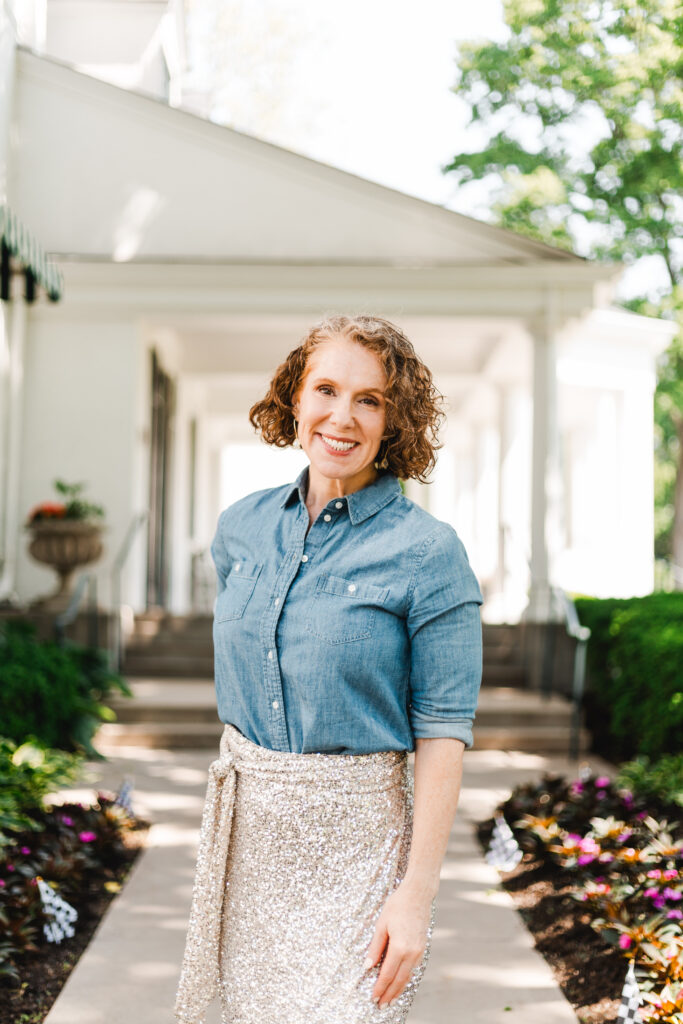
Credit where it’s due. If you need a clean, professional-looking image today, for a conference badge, an internal directory, a placeholder while you get around to the real thing, AI delivers. It’s fast, it’s cheap, and it beats the pixelated cropped vacation photo a lot of profiles are still running.
If that’s the job, use it. I mean that. A decent AI headshot is better than no photo at all.
The promise problem
This is where it gets complicated. Your photo isn’t decoration. It’s a promise about who is going to show up.
AI-generated images have a pattern: they’re you on a day that never happened. Smoother, more symmetrical, lit like a magazine, wearing clothes you don’t own, sitting in an office that doesn’t exist. Each choice seems harmless. Stacked together, they open a gap between the photo and the person. The moment someone meets you, at a networking event in Carmel or on a discovery call, that gap becomes the first impression. Not “she looks great.” More like “huh, she looks different than her photos.”
For a small business owner, trust is the whole game. You’re not the face of a faceless brand. You are the brand. A photo that overpromises quietly undermines the exact thing it was supposed to build!
What AI can’t photograph
The bigger limitation isn’t your face, though. AI can generate a version of you. What it can’t generate is evidence.
It can’t capture your actual studio, storefront, or home office. It can’t shoot how you work with a client, the process behind the finished thing, your team mid-laugh, your dog asleep in the corner while you edit. Those aren’t aesthetic touches. They’re proof that you exist, in a specific place, doing real work with real people. That proof is what makes someone in Fishers or Westfield choose you over a national option with a bigger ad budget.
Real photos also feed everything around them: your Google Business Profile, your reviews, your local visibility. The same AI tools generating images are also deciding which businesses to recommend when someone asks, and specific, consistent imagery of an actual business is part of what earns that trust. A generated headshot builds none of it, because there’s nothing behind it.
And then there’s video. A still image can be generated. A twenty-second clip of you explaining what you do, in your own voice, with your hands moving the way they do? That’s still yours alone.
One photo versus a working library
Even a perfect AI headshot is one image, and your business doesn’t run on one image. It runs on the website header, the launch graphics, the email photos, the Reels, the about page, the speaking bio, the post you need next Tuesday. A real session produces a bank of material with range: 60+ images and 15+ video clips in a single day from my most-booked package, all recognizably, verifiably you.
How I’d split it AI generated headshots vs real photos
Use AI where it’s brilliant: planning out your calendar, turning a blog post into caption drafts, drafting the emails you keep putting off, resizing and organizing what you already have created. That’s leverage, and I encourage clients to use it where it fits best in your business!
Use REAL content for proof: your face, your space, your work, your people. That’s trust, and (currently) there’s no shortcut to it.
The businesses getting this right aren’t choosing between AI and real content. They’re using AI to squeeze more out of the content that IS real!
Where I fit in
I sit in an odd spot for this conversation. I shoot the real photos, and I help business owners set up their AI. So I won’t tell you AI is a gimmick, and I won’t pretend a generated headshot builds the same trust a real one does. Both things are true at once, and the owners who understand the difference are pulling ahead.
If your visuals need to do more than exist, let’s plan your content. Start at kelliwhitephotography.com.
FAQ
Are AI headshots good enough for LinkedIn? As a placeholder, sure. If LinkedIn is where your clients form their first impression of you, a real headshot pays for itself quickly. A quick headshot session takes less time than most people expect.
Will people be able to tell my photo is AI? Increasingly, yes. People are getting sharp at spotting the too-smooth, too-perfect look, and feeds are filling up with it. Blending in with generated content is its own risk.
Is it wrong to use AI images in my business? It’s a fit question, not a morals question. For decorative graphics or mockups, generated images are fine. For the face of your business and proof of your actual work, you need to be showing real wins.
Can I use AI to edit my real photos? Yes, and that’s a great use of it. Cleanup, resizing, converting formats for different platforms. Editing a real photo keeps the truth of it intact. Generating a new one doesn’t.
Should I be using AI for the rest of my marketing? Almost certainly. Planning, repurposing, and writing support are where AI genuinely saves hours every week, and that’s a growing part of what I help clients set up.





+ view comments . . .